Taking commission work can be frustrating
3D designing a modular trophy with the customer sitting next to you.
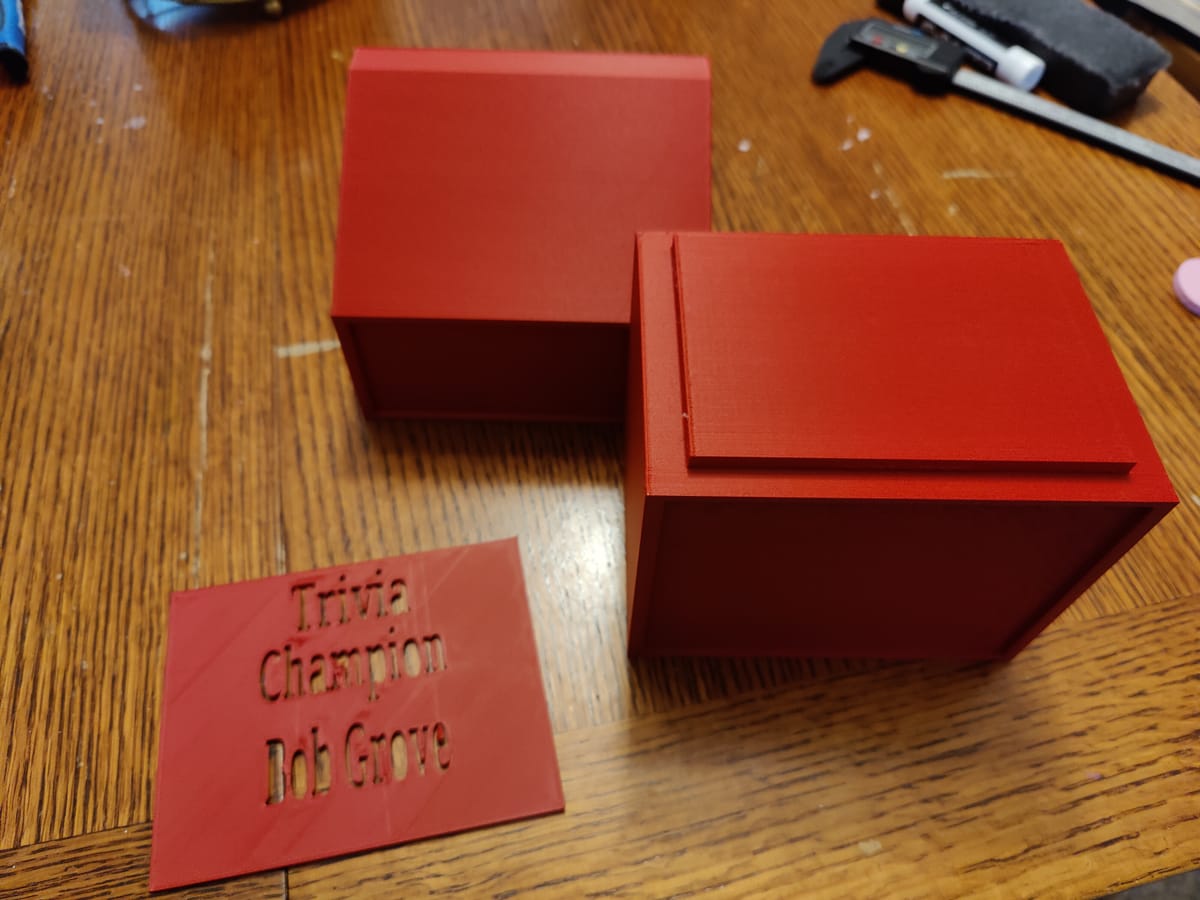
In the intricate world of custom commission work, the journey from a client's vision to a tangible reality is often a blend of frustration and fulfillment, especially in the realm of 3D design. My latest project, the crafting of a modular 3D-printed trophy, serves as a perfect example. This trophy, designed to celebrate trivia champions, posed unique challenges with its multifaceted structure: a rectangular base featuring a personalized nameplate, a middle section representing the number of victories, and a top piece bearing the company's name. This project not only tested my creative and technical skills but also offered a profound insight into the delicate balance of meeting client expectations while pushing the boundaries of 3D printing technology. The experience was a vivid reminder of the highs and lows that come with bringing someone's vision to life, embodying the essence of commission work in the modern creative landscape.
Speaking of rectangular base, this is the picture they sent me as their inspiration:
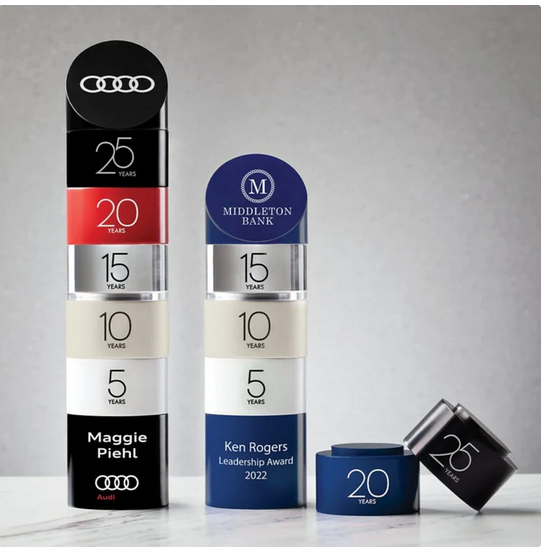
I feel I can be forgiven if I started down the design as a round piece. However the client wanted a simpler design, a square (they actually meant rectangle). I digress though, so let’s talk about bullet point number 1.
Client Expectations
Navigating client expectations is the most important aspect of commission all work, particularly in complex projects like the design of a 3D-printed, modular trophy. Each client comes with a unique vision, often coupled with specific requirements that can challenge even the most experienced designers, which, I am not. In this project, the client envisioned a trophy that was not just an award, but a symbol of recurring achievement, with a base for personalization and a middle section to denote the number of victories. Probably in multiples of 5, but as of yet, undetermined.
Understanding these expectations required some back and forth communication and a deep dive into the client's objectives. Turns out, this is a bit of a gag gift. This initial phase of aligning thoughts and ideas is crucial, as it sets the foundation for the entire project. It involves listening intently, asking the right questions, and sometimes, reading between the lines to capture the essence of what the client truly desires. This process, although sometimes arduous, is essential for ensuring that the final product not only meets but exceeds the client's expectations, turning their conceptual dream into a 3D-printed reality. In this case, since it’s a bit of a humorous award, it really can’t cost very much. the slicer suggests we’re already at roughly $20 with the prototype. We’re going to have to do better than that for it to be sustainable and for me to actually make money.
I had the client sit next to me while we super fast mocked up, first a white board example, then used tinkercad to very quickly make a prototype. If you haven’t used tinkercad, it’s a great way to make something super quick if the shapes are simple. I’ll eventually move this design into FreeCad, which if I’m being honest, is pretty terrible, but you know… free. If you know of a better solution that runs in Linux, or a web browser, drop it in the comments, but don’t say Fusion360, it’s not even cheap. Scrubs like me can’t afford that crap.
Creative Challenges and Solutions
The creative journey of designing the 3D-printed trophy was fraught with challenges, requiring a delicate balance between innovation and cost-effectiveness. One of the primary hurdles was crafting a design that was both aesthetically pleasing and functional, yet affordable enough to ensure client satisfaction and profitability. To achieve this, I employed a strategy of using cost-efficient materials that didn't compromise the trophy's quality. Inexpensive filament, like Polymaker’s PLA is super nice for this purpose. I also optimized the design for 3D printing, reducing material waste and printing time. Mostly orienting the print so it generates the least amount of support material. The trophy by itself is already somewhat cost effective because I created a modular design that allowed for easy customization and scalability - a single design could be adapted for multiple winners, saving on both design time and production costs. The base, middle and top pieces all being the same for each person, with simple name plates to print by themselves, which will only cost a few cents to print. By streamlining the design and production process, I was able to keep costs low without sacrificing the trophy's integrity or appeal. This approach not only delighted the client with an affordable yet also humorous trophy but also ensured that the project remained financially viable, striking the closest balance between creative expression and practical business sense.
Technical Design Aspects
The technical intricacies of 3D design played a crucial role in the creation of the modular trophy. One of the foremost considerations was selecting the appropriate material that would ensure durability while being suitable for fine-detail printing. I chose a high-quality, yet cost-effective, thermoplastic, Polyterra PLA, that offered the necessary strength and a nice matte finish. Another significant aspect was designing for modularity, which required precise calculations to ensure that each piece of the trophy seamlessly interlocked with the others. I’m not going to brag, actually this is literally a brag, the prototype fit together perfectly on the first try. Do you know how hard that is? Ok, maybe if it’s your day job, but for me, it’s a side hustle, uhhhh hobby, I mean hobby.
This not only enhanced the trophy's aesthetic appeal but also allowed for easy assembly and disassembly, catering to the modular nature of the award. It fits together well enough that he doesn’t need to use adhesive, but could if he wants to.
Additionally, optimizing the design for 3D printing was essential to avoid common pitfalls like warping or inaccuracies during printing. This involved careful consideration of factors like print orientation, support structures, and layer resolution. Balancing these technical elements was a meticulous process, demanding a deep understanding of 3D printing technology and a keen eye for detail, all to ensure the final product was not only visually striking but also structurally sound and true to the client’s vision.
But what does it look like you ask, pics or it didn’t happen or something….
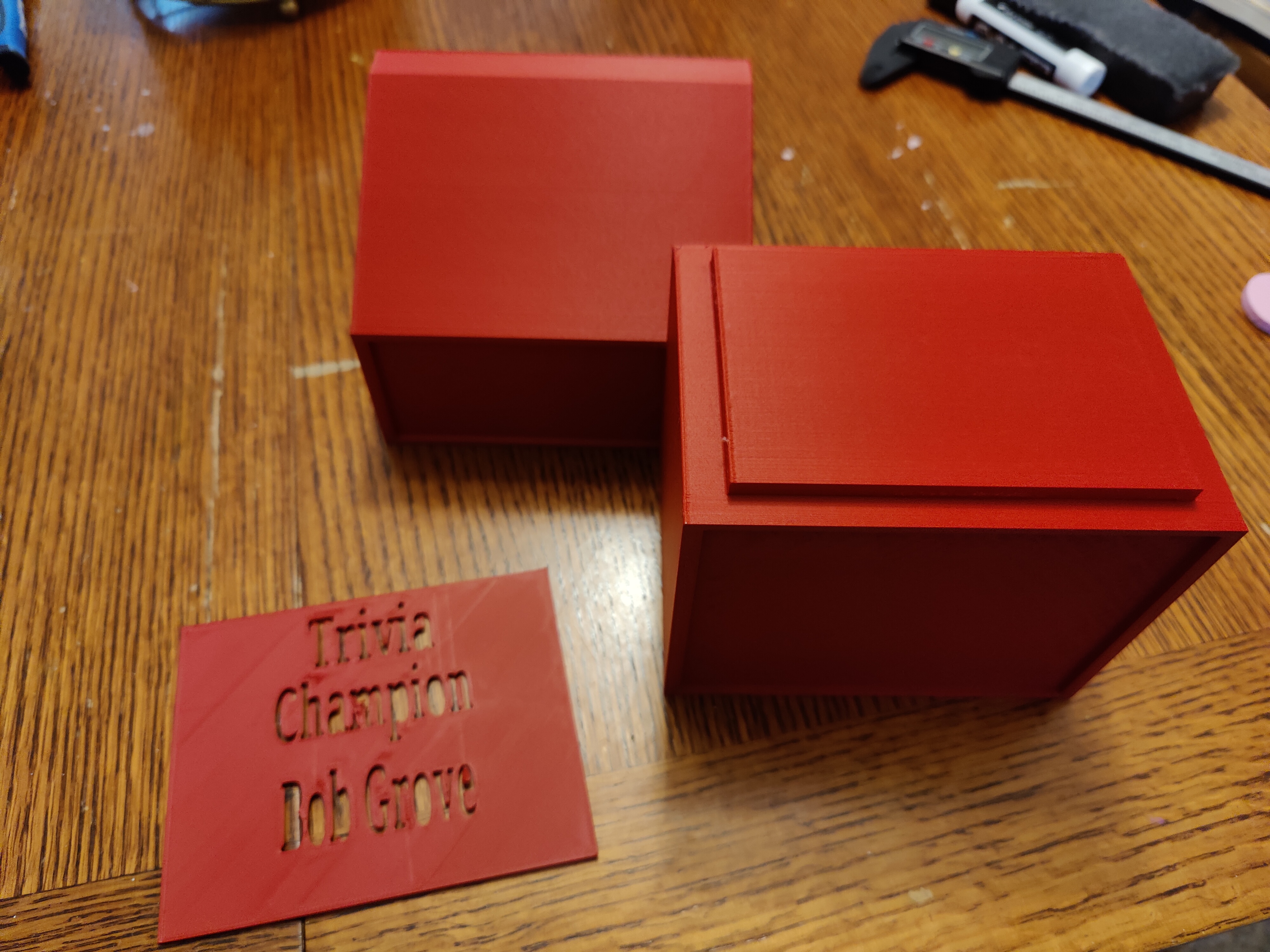
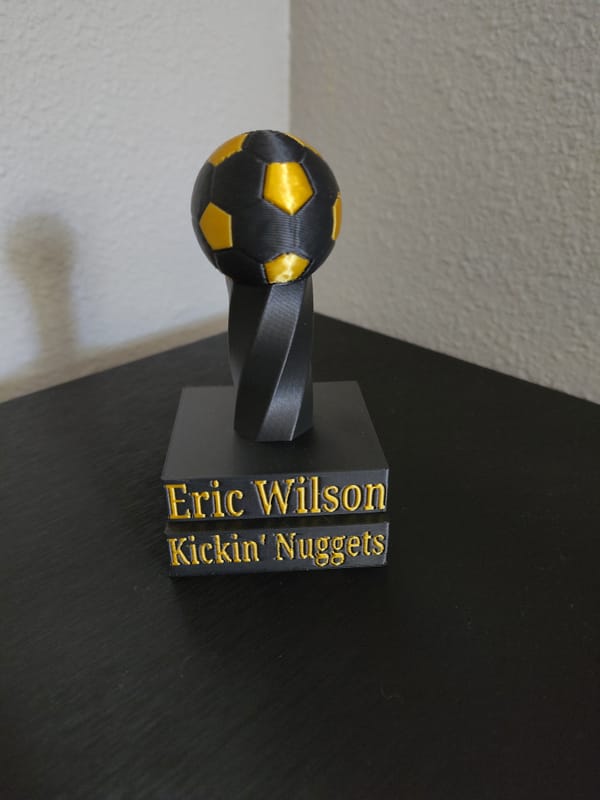
Wow, that’s terrible… All these words I’ve read so far and that’s all you have to show for it?! I know… turns out I forgot to put a backing on the font so the middles of the letters actually have something to stick to, also print it in a different color. Trivia Champion is supposed to be in white. I forgot to do that. Listen, I make mistakes, for that you should realize I’m just a scrub, trying to make internet content for you to mindlessly scroll through and you should subscribe to my Substack so I don’t get dejected and stop making/writing.
Here’s a picture of the pieces fitting together, even if the name plate is terrible.
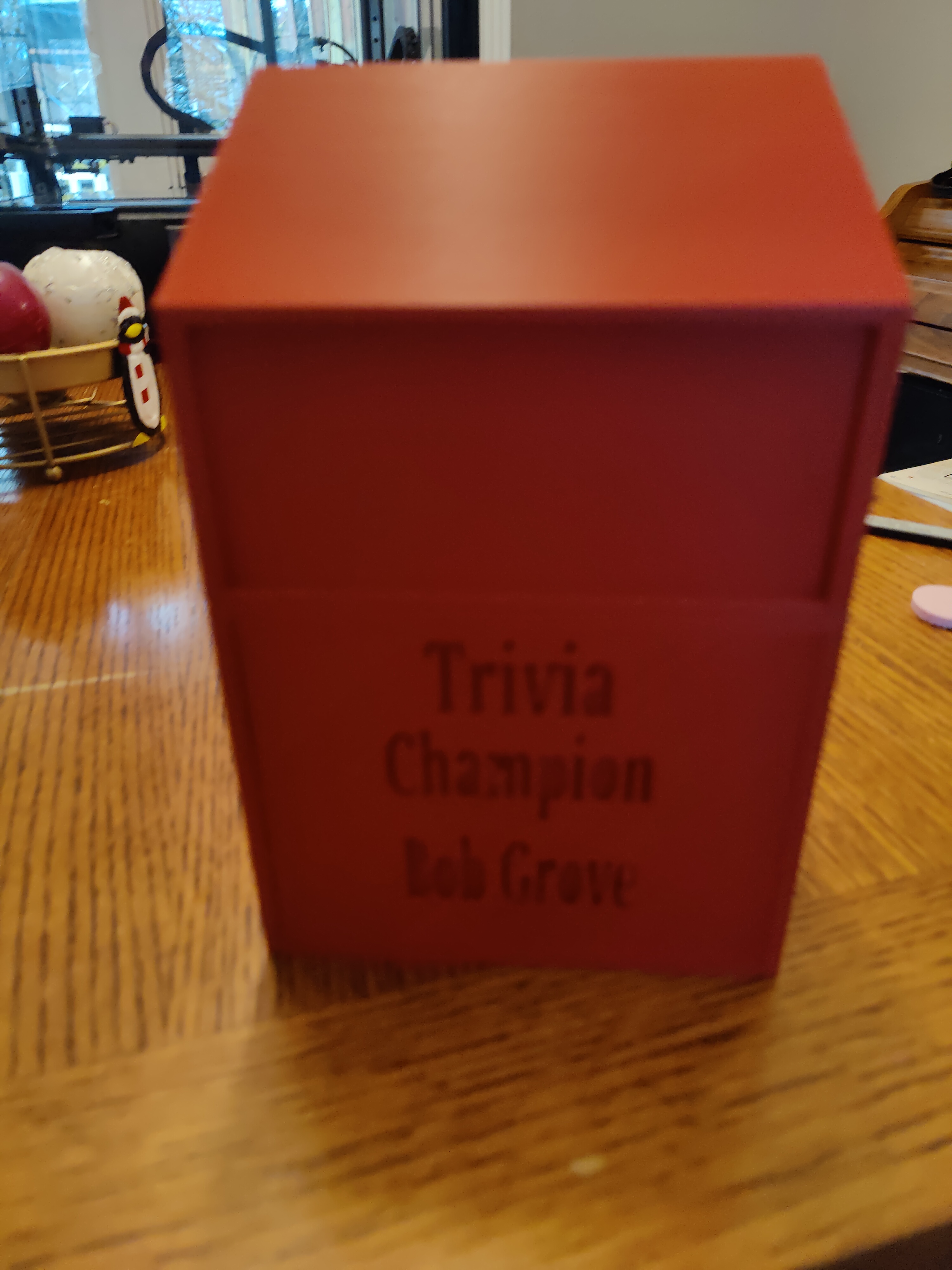
Fun fact, that printer in the background is a BROKEN Vivedino Troodon 300.
Client Interaction and Feedback Loop
The client interaction and feedback loop for the trophy project, predominantly conducted through text messages, presented its own set of challenges. Communication via text, while convenient, often led to misunderstandings and sometimes unhelpful suggestions from the client. Let’s face it though, it’s a remote working world now, despite billionaire attempts at controlling their campuses.
The client, enthusiastic yet unfamiliar with the technicalities of 3D design, occasionally proposed ideas that were impractical or beyond the scope of the project's budget. Navigating these suggestions tactfully, I had to strike a balance between accommodating the client's input and steering the project towards feasible solutions. This process underscored the importance of clear, patient communication and the skill of gently guiding the client towards more realistic options, all while keeping their enthusiasm and vision intact. It was a delicate dance of managing expectations and ensuring the final product aligned with both the client's aspirations and the project's practical constraints. Speaking of which, we don’t actually have a final product yet, because during the prototype print, my store got enough orders that with my fast printer (the broken Troodon) out of commission, I had to stop and make all the orders. If you’ve never visited my store, you should check it out. Maybe buy something. I make some cool stuff, for you. Damn that would have been a better name. but anyway….
The Satisfaction of Seeing the Concept Realized
I'm pretty excited about this project. It's a great way to use 3D design and printing to solve small workplace issues, and the satisfaction of seeing the concept realized is truly unparalleled. From the initial sketches to the final, polished (not literally of course) modular trophy in my hands, each step of this journey has been a testament to the transformative power of technology in custom design.
The ability to turn a client's abstract idea into a tangible, functional object that captures the spirit of their vision is incredibly rewarding. Witnessing their delight and the pride (I assume? It’s probably a crappy forced workplace safety thing, who am I kidding) of the trivia champions as they receive a trophy tailored just for them reaffirms the value of my work. This project, beyond its technical and creative demands, highlights the unique joy and fulfillment that comes from bridging the gap between imaginative concepts and real-world solutions. It's a vivid reminder of why I ventured into the world of 3D design and printing – to bring ideas to life and make a tangible difference, one project at a time.
Don't miss out on being a part of the coolest crowd in town - subscribe to my free Substack! It's the one decision you won't regret, unlike that questionable haircut in 2009. Like for real, you can’t pull off bangs. Terrible.